
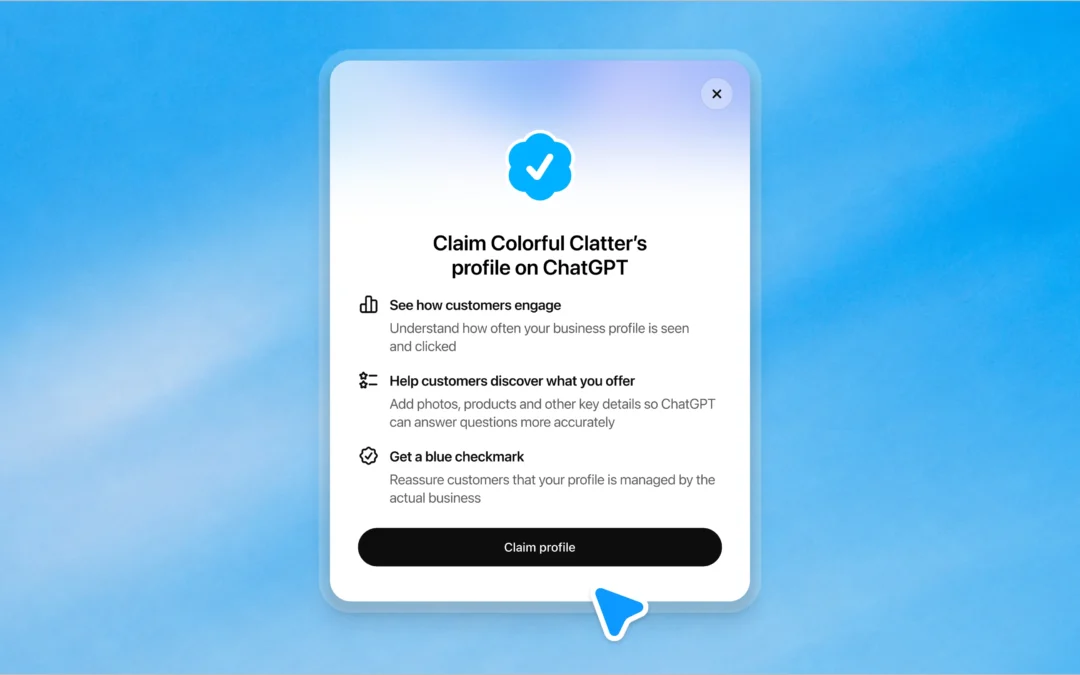
ChatGPT Business Hub is live. Google Business Profile has a new neighbour.
OpenAI just introduced a new way for businesses to manage how they appear in ChatGPT. Here’s what’s changing, why it matters for small businesses, and what you should be doing about it.
For years, businesses have been told to make sure they’re visible on Google. Get your website ranking, optimise your Google Business Profile, collect reviews, keep your information updated. All perfectly good advice. None of it is going away.
There’s a new place where potential customers are discovering businesses, comparing services and deciding who to contact. And until now, business owners have had very little control over what happens there.
On 10 November 2026, OpenAI launched Businesses in ChatGPT, introducing a new Business Hub that allows businesses to claim their profiles, manage their information and access insights into how they appear in ChatGPT.
Not because Google is suddenly obsolete. But because the way people find businesses is becoming more complicated, and much more conversational.
https://openai.com/index/introducing-businesses-chatgpt/?video=1245272094
So, what exactly is ChatGPT Business Hub?
Think of it as an early equivalent of Google Business Profile, but built for a platform where customers ask questions rather than simply browse search results. OpenAI is introducing three main capabilities.

1. Claim and manage your business profile
Eligible businesses can now claim their presence in ChatGPT and, once verified, manage key information about their company. This includes business descriptions, contact information, website details and the products or services they offer. Retailers can also provide product feeds, including current pricing and availability. Shopify merchants have a dedicated integration to make this process easier.
Why does this matter? Because when someone asks ChatGPT about your business, you probably want it working with accurate information rather than an outdated description, an old website page or incomplete details collected elsewhere. Business Hub gives companies a more direct way to provide that information. It doesn’t mean you’ll control every answer ChatGPT produces. But it’s a useful start.
2. Find out how often ChatGPT mentions your business
This might actually be the most interesting feature for marketers and business owners. Until now, measuring visibility in AI search has been something of a guessing game. You could ask ChatGPT whether it recommends your company, experiment with different prompts or use third-party monitoring tools. But getting reliable information directly from the platform was difficult. Business Hub introduces aggregated insights covering:
- Mentions: How often your business is referenced in qualifying ChatGPT results.
- Website clicks: How often users click through to your website.
- Discovery topics: The themes and subjects associated with conversations where your business appears.
The reporting currently covers a rolling 28-day period.
There are some important limitations. For online businesses, a recorded mention generally requires ChatGPT to reference the business’s website; simply naming the brand doesn’t necessarily count. OpenAI also applies privacy thresholds, meaning some data may be unavailable.
Businesses won’t have access to individual customer conversations. Still, for anyone working in SEO or digital marketing, this is an interesting development. We’re beginning to see more concrete ways of measuring visibility beyond traditional search engines.
3. Let customers speak directly with your AI Business Agent
This is where things start getting particularly interesting. OpenAI is also introducing Business Agents. Rather than just reading about a business, ChatGPT users may be able to start a separate conversation with an AI agent representing that company.
Imagine someone shopping for a new bicycle. They ask ChatGPT to compare different options. A retailer appears in the recommendations. The customer can then open that retailer’s Business Agent and ask about sizing, specific products, features or return policies. The agent uses information provided by the business to answer those questions. It’s a different type of customer interaction, and one that could become an interesting part of the buying journey.
For now, Business Agents are only available to eligible e-commerce and online service businesses in the US.
The current experience is primarily about answering questions and directing people towards a business’s website. Purchases and bookings aren’t completed within the agent itself. OpenAI has also introduced the possibility of sponsored Business Agents, clearly separated from ChatGPT’s independent recommendations.

Why this matters for small businesses
Here’s where I think things get particularly relevant. Imagine you run an independent language school in Edinburgh. A few years ago, someone looking for evening Spanish classes would probably type something like: Spanish classes Edinburgh
They’d get a Google results page, compare a few websites, read some reviews and eventually make a decision.
Today, that same potential customer might ask ChatGPT: I’m looking for beginner Spanish evening classes in Edinburgh. I work full-time, I’d prefer small groups, and I don’t want to spend more than £200. What would you recommend?
That’s a completely different interaction.
The customer isn’t necessarily searching for a particular website. They’re explaining their needs and asking for a recommendation. And the businesses that ChatGPT identifies, understands and considers relevant may become part of that customer’s shortlist before they’ve even visited a website. This doesn’t mean traditional SEO is dead. Quite the opposite. Your website, its content, your reputation and the clarity of your business information still matter enormously. But we now need to think beyond whether a website ranks for a particular keyword. We also need to consider whether AI-powered search tools can understand what the business offers, who it serves and why someone might choose it.
Does claiming your ChatGPT profile improve your rankings?
No. Claiming your business does not automatically make ChatGPT recommend you more often.
OpenAI is quite clear about this. Business profiles allow companies to provide and update information, but ChatGPT’s independent recommendations remain separate. There’s no magic button that suddenly puts your business at the top of every AI-generated recommendation. And I suspect we’ll soon see plenty of questionable marketing services promising exactly that. You can already imagine the emails: “Get your business ranked #1 on ChatGPT in 7 days!” I’d be very sceptical.
Like traditional SEO, visibility in AI-powered search involves more than simply filling in a profile. Your business needs credible, accessible and useful information that helps answer genuine customer questions.
What should your business do now?
You don’t need to completely rethink your digital marketing strategy overnight but there are a few sensible things worth doing.
Check whether you can claim your business
Start with ChatGPT Business Hub.
Eligible businesses can search for their company and begin the verification process. Availability depends on the business type and location, and access is still being rolled out. You’ll need to prove that you’re authorised to represent the business. OpenAI also requires additional identity verification before you can publish updates or access insights. The ability to claim a business is broader than the initial US-only availability of Business Agents, although some categories, particularly physical local businesses, still face restrictions.
Make sure your website actually explains what you do
This sounds obvious, but you’d be surprised how many websites fail at it. Beautiful design. Plenty of animations. Lots of vague marketing language. But very little practical information. If someone asks an AI assistant about your prices, the areas you serve, your services or what makes you different, is that information actually available on your website?
Clear service descriptions, useful FAQs, pricing information where appropriate, genuine examples of your work and customer reviews can all help potential customers understand your business. The objective shouldn’t be to write content for a machine. It should be to make your business genuinely easy to understand.
Don’t neglect the technical side
Your content needs to be accessible too. OpenAI uses a crawler called OAI-SearchBot to discover website content for ChatGPT search features. If your website or hosting configuration blocks it, that can affect whether your content is eligible to appear in search results. This is something worth checking alongside your existing technical SEO setup. And no, you don’t need to buy an expensive new ‘AI SEO platform’ simply to make this work.
Keep your business information consistent
Your website says one thing. Google Business Profile says another. An old directory listing still has your previous address. It’s hardly ideal. Maintaining consistent, accurate business information across your website and online profiles is useful for customers, search engines and AI-powered discovery tools alike. Business Hub is another place to maintain those details, not a reason to abandon the existing ones.
Start paying attention to AI visibility
If Business Hub insights are available for your company, use them. Look at the topics associated with your business, the website clicks and how that activity changes over time. Compare those insights with your website analytics. And remember that a mention isn’t the same as a lead, just as a Google impression isn’t the same as a paying customer. The metrics are interesting, but the commercial outcomes still matter more.
Your website isn’t becoming less important. It’s becoming more important.
One thing I find interesting about all these developments is how often people predict the death of websites. AI will replace websites. Nobody will use Google. Businesses won’t need SEO anymore. We’ve heard variations of these predictions for years. But consider what OpenAI is actually introducing.
A way for companies to provide accurate business information. A way to connect products and services to potential customers. A way to help people find answers about a business before deciding what to do next.
And where does much of that business information come from? Your website. Where do customers still go to complete purchases, make bookings or contact a company? Very often, your website.
A good website is no longer just a digital brochure. It’s a reliable source of information about your business, available to customers and increasingly to the systems helping those customers make decisions. That makes good web design, thoughtful content, technical SEO and a clear marketing strategy every bit as relevant as before. Perhaps more so.
Need a hand making your business easier to find?
I work with small businesses on web design, SEO, content and digital marketing. Not just to make websites look good, but to make sure they communicate clearly, work properly and help the right people discover what a business offers. Whether someone finds you through Google, ChatGPT or somewhere else entirely, the fundamentals still matter.
Source: OpenAI — Introducing Businesses in ChatGPT, 10 November 2026.