
If you’re looking for a new website for your small business, one of the first questions you’ll probably ask is:
How much should a website actually cost?
Unfortunately, the answer isn’t as simple as it should be.
You can find people offering websites for £300. You can build one yourself for less than £20 a month. A freelancer might quote £1,500–£3,000, while an agency could easily charge £5,000, £10,000 or considerably more.
So, what should a small business in the UK realistically expect to pay for a website in 2026?
For most small businesses, a professionally designed website will typically cost somewhere between £1,000 and £5,000, depending on its size, functionality, content, SEO requirements and who builds it.
But price alone doesn’t tell you whether you’re getting good value.
Let’s break down what you’re actually paying for.
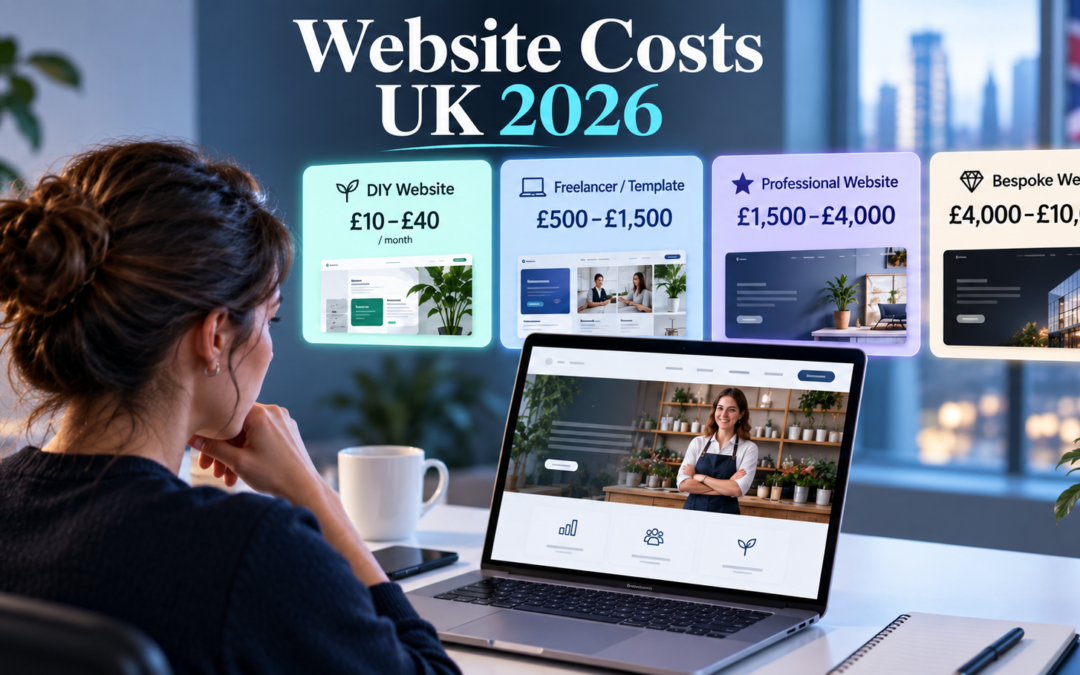
Small business website costs in the UK: a quick overview
Here is a realistic guide to the different options available in 2026.
| Type of website | Typical cost |
|---|---|
| DIY website builder | £10–£40+ per month |
| Very basic freelancer/template website | £500–£1,500 |
| Professional small business website | £1,500–£4,000 |
| Larger or more bespoke business website | £4,000–£10,000+ |
| E-commerce website | £2,500–£10,000+ |
| Bespoke development/platform | £10,000+ |
These figures aren’t fixed prices. A five-page brochure website and a five-page website with online bookings, CRM integration, multilingual content and bespoke functionality are completely different projects.
The important question isn’t simply “How many pages do I need?”
It’s:
“What does my website need to do for my business?”
1. Building your website yourself: around £10–£40+ per month
Platforms such as Wix, Squarespace, Shopify, Hostinger and WordPress.com have made it much easier to create a website without hiring a designer.
For a new business with almost no budget, this can make sense.
You’ll normally pay a monthly or annual subscription covering things such as your website builder, template and hosting.
The financial cost can therefore be relatively low.
The hidden cost is your time.
You still need to decide how the site should be structured, write the copy, source images, create the design, make it work properly on mobile, understand basic SEO and connect tools such as analytics and Google Search Console.
A DIY website can be perfectly suitable if you need a simple online presence and are comfortable doing the work yourself.
But if your website is expected to generate enquiries and customers, simply having a website isn’t necessarily enough.
2. Cheap or template-based websites: roughly £500–£1,500
At the lower end of the professional market, you’ll find freelancers and small providers offering websites from a few hundred pounds.
These websites will often use an existing template with your colours, logo, text and images added.
There’s nothing inherently wrong with using templates.
In fact, most modern websites use frameworks, themes, page builders or reusable design systems in some form.
The question is how much thought goes into the final website.
At this price point, you should check exactly what is included.
Does the price include professional design?
Is the website customised to your business?
Does somebody help structure your pages?
Is SEO considered?
Who writes the content?
Is mobile optimisation included?
What happens if you need changes?
Who owns the website when the project is finished?
A £700 website can become expensive surprisingly quickly if you later need to pay someone else to fix, rebuild or optimise it.
3. A professionally designed small business website: around £1,500–£4,000
This is the range where many UK small businesses will find the best balance between quality and cost.
Rather than simply putting your logo into a template, the project should consider your business, customers and marketing goals.
A professional small business website would normally include things such as:
A clear website structure.
Professional and consistent design.
Mobile and tablet optimisation.
Contact forms and conversion points.
Basic technical SEO.
Search-friendly page structures.
Google Analytics and Search Console setup or integration.
Performance optimisation.
Security and backups.
Support during the launch.
Training or an easy way to manage the website afterwards.
Most importantly, your website should be built around what you want visitors to do next.
That might be requesting a quote, booking an appointment, visiting your shop, calling you, joining a course or buying a product.
A beautiful website that doesn’t generate business isn’t necessarily a good website.
4. Larger or bespoke business websites: £4,000–£10,000+
Costs increase when a project involves more content, more strategy or more complex functionality.
For example, a £2,000 website might become a £5,000+ project if it requires multiple service areas, dozens of pages, multilingual content, advanced forms, booking systems, memberships or integration with external platforms.
Bespoke design and development can take the price significantly higher.
This doesn’t mean every small business needs an expensive bespoke website.
Most don’t.
If WordPress or another established platform can achieve what you need reliably, paying tens of thousands of pounds for custom development may offer little additional value.
The technology should fit the business — not the other way around.
What actually affects the cost of a website?
Two businesses can both ask for a “five-page website” and receive completely different quotes.
That’s because the number of pages is only one part of the project.
Design
Is the designer adapting an existing layout or creating something specifically around your brand?
Custom design naturally requires more work.
But good design isn’t only about colours and fonts.
It includes navigation, hierarchy, calls to action, mobile usability and making information easy to understand.
Content and copywriting
Who is writing the website?
If you provide polished, final copy, the project may require less work.
If your designer needs to understand your business, research competitors, structure your services and rewrite your content, you’re also paying for marketing and copywriting expertise.
That can be extremely valuable.
For many small businesses, the website project is actually the first time they’ve properly defined how to explain what they do.
SEO
A website can look excellent and still be almost invisible on Google.
SEO work might include keyword research, page titles, meta descriptions, headings, internal linking, image optimisation, schema, local SEO and technical improvements.
More advanced projects may also require dedicated location pages, service pages or an ongoing content strategy.
If attracting customers through Google matters to your business, SEO should be considered while the website is being built, not added as an afterthought six months later.
Number of pages
More pages generally mean more design, copy, optimisation and testing.
But ten well-planned pages can sometimes be more valuable than a beautifully designed three-page website.
For example, a local business serving Edinburgh might benefit from dedicated pages for its main services rather than putting everything onto one generic “Services” page.
E-commerce
Selling products online introduces additional work.
You need product templates, payment processing, shipping settings, transactional emails, product variations, tax settings, checkout optimisation and potentially integrations with stock or accounting systems.
That’s why e-commerce websites generally cost more than straightforward service-business websites.
Booking systems and integrations
Appointment bookings, CRM systems, email marketing platforms, membership areas, APIs and external software all add complexity.
Sometimes the integration itself is straightforward.
Sometimes making several systems communicate reliably takes considerably longer.
What other website costs should you budget for?
The initial website build isn’t always the only cost.
Domain name
Your domain will normally cost around £10–£30 per year for a typical .co.uk or .com, although premium domains can cost considerably more.
Hosting
WordPress hosting can range from a few pounds per month to £50+ depending on the provider, traffic, performance and level of support.
For a normal small business website, you usually don’t need enterprise-level hosting.
But I’d also avoid choosing hosting purely because it’s the cheapest available.
Website speed, backups, security and technical support matter.
Maintenance
WordPress itself needs very little day-to-day management, but themes and plugins should be kept updated.
You also need backups, security monitoring and occasional technical maintenance.
Some businesses handle this themselves.
Others pay their web designer or agency for ongoing support.
Premium software and plugins
Some websites use premium plugins for forms, SEO, bookings, security, multilingual content or other functionality.
Ask whether licences are included in your website price and what happens when they renew.
SEO and marketing
Building the website and generating traffic are two different things.
Your website gives you the platform.
SEO, Google Business Profile optimisation, Google Ads, social media, content and email marketing can then help bring potential customers to it.
Why does one web designer charge £800 and another £4,000?
Because you’re rarely buying exactly the same thing.
Imagine hiring someone to create a five-page website.
Designer A takes a template, adds your logo and asks you to supply all the text and images.
Designer B researches your competitors, helps position your services, recommends a better site structure, rewrites your content, carries out keyword research, builds the website, optimises it for Google, installs analytics and advises you on what to do after launch.
Both can technically advertise a “five-page website”.
They’re very different services.
This is why comparing website quotes purely on price can be misleading.
Instead, compare what you’re actually getting.
Freelancer vs web design agency: which is better?
Neither is automatically better.
A larger agency can give you access to separate designers, developers, account managers, copywriters and SEO specialists.
That can be useful for large or complex projects.
But it also means more overheads — and usually a higher price.
A freelancer or small consultancy can offer a more direct relationship, lower costs and greater flexibility.
For a small business, working directly with the person actually planning and building your website can be particularly valuable.
The right choice depends on the scale of the project.
If you’re launching an international platform with complex custom development, you’ll probably need a larger development team.
If you’re a local business that needs a professional WordPress website designed to generate enquiries, you may not.
How much should a small business spend on a website?
There’s no magic percentage.
I prefer looking at the website in terms of what it can realistically contribute to the business.
Imagine spending £2,000 on a website.
If the average new customer is worth £500 to your business, the website only needs to help generate four additional customers to cover that initial investment.
For a solicitor, consultant, tradesperson, language school, healthcare provider or B2B company, a single new customer could potentially cover a significant proportion of the website cost.
That’s why I don’t think the goal should be to build the cheapest possible website.
It should be to build the simplest website capable of achieving your objectives.
Those are very different things.
How much does Rekito charge for a small business website?
At Rēkito Digital, I primarily build WordPress websites for small businesses, independents and local organisations.
Projects are designed around more than appearance.
I look at your services, positioning, customer journey, SEO and future marketing before deciding how the site should be structured.
For a typical small business, website projects generally start around £1,600, with more comprehensive projects around £2,500+, depending on what is required.
The goal isn’t to sell you functionality you don’t need.
It’s to build a professional website that gives your business a strong foundation for SEO, Google Ads, social media and future marketing.
I’m also not interested in locking clients into a platform they can’t control.
Your website should be an asset that belongs to your business.
Is WordPress still a good choice for small businesses in 2026?
Yes — for many businesses, WordPress remains an excellent option.
It gives you considerably more control than many closed website builders and can grow with the business.
You can start with a relatively simple website and later add landing pages, booking functionality, multilingual content, e-commerce or integrations without necessarily having to rebuild everything.
It’s also extremely flexible for SEO.
WordPress isn’t automatically the right platform for every project, though.
A very simple side project might be perfectly happy on Squarespace or Wix.
A large e-commerce operation might be better suited to Shopify.
The platform should be chosen based on what your business needs now and where it’s likely to go next.
Can you get a good business website for under £1,000?
Yes.
But you’ll normally need to compromise somewhere.
That might mean supplying your own content, accepting a more standard design, having fewer pages or doing more of the work yourself.
For a very new business, that can sometimes be the right decision.
The important thing is knowing what isn’t included.
If your £700 website later requires £1,500 of SEO work, copywriting and technical fixes, it wasn’t necessarily the cheaper option.
Is £2,000 expensive for a website?
For a professionally designed small business website, £2,000 is a normal budget rather than an unusually high one.
What matters is the scope.
If you’re paying £2,000 for someone to install a template and replace the text, you may not be receiving particularly good value.
If the project includes strategy, design, content support, SEO, optimisation and launch support, the same £2,000 can represent very good value.
Ask what you’re getting rather than focusing only on the final number.
How long does a small business website take to build?
A straightforward website might be completed within a few weeks.
More complex projects can take considerably longer.
The biggest delays aren’t always technical.
Content, photography, approvals and feedback often take more time than building the website itself.
Having your branding, services and objectives clear before the project begins can make the process considerably smoother.
The bottom line: what should you budget in 2026?
If you’re launching a small UK business and simply need something online, you can absolutely start with a DIY website for a relatively small monthly cost.
If you want a professionally built website that represents your business properly and can support your marketing, £1,500–£4,000 is a sensible starting budget for many small businesses in 2026.
Complex websites, e-commerce and bespoke development will cost more.
The cheapest option isn’t automatically bad.
The most expensive option isn’t automatically better.
What matters is whether the website is appropriate for your business, easy for customers to use, visible to search engines and capable of supporting your growth.
Looking for a new small business website?
If you’re planning a new website or wondering whether your existing one needs improving, I can help you work out what you actually need before you spend money on it.
Rēkito Digital creates WordPress websites for small businesses in Edinburgh, across the UK and beyond — combining web design, SEO and practical marketing strategy.
Tell me about your project and I’ll recommend the simplest approach that makes sense for your business.